


‘They trust the process no matter what’: Inside the superpower that carried the Rays to the World Series

Share
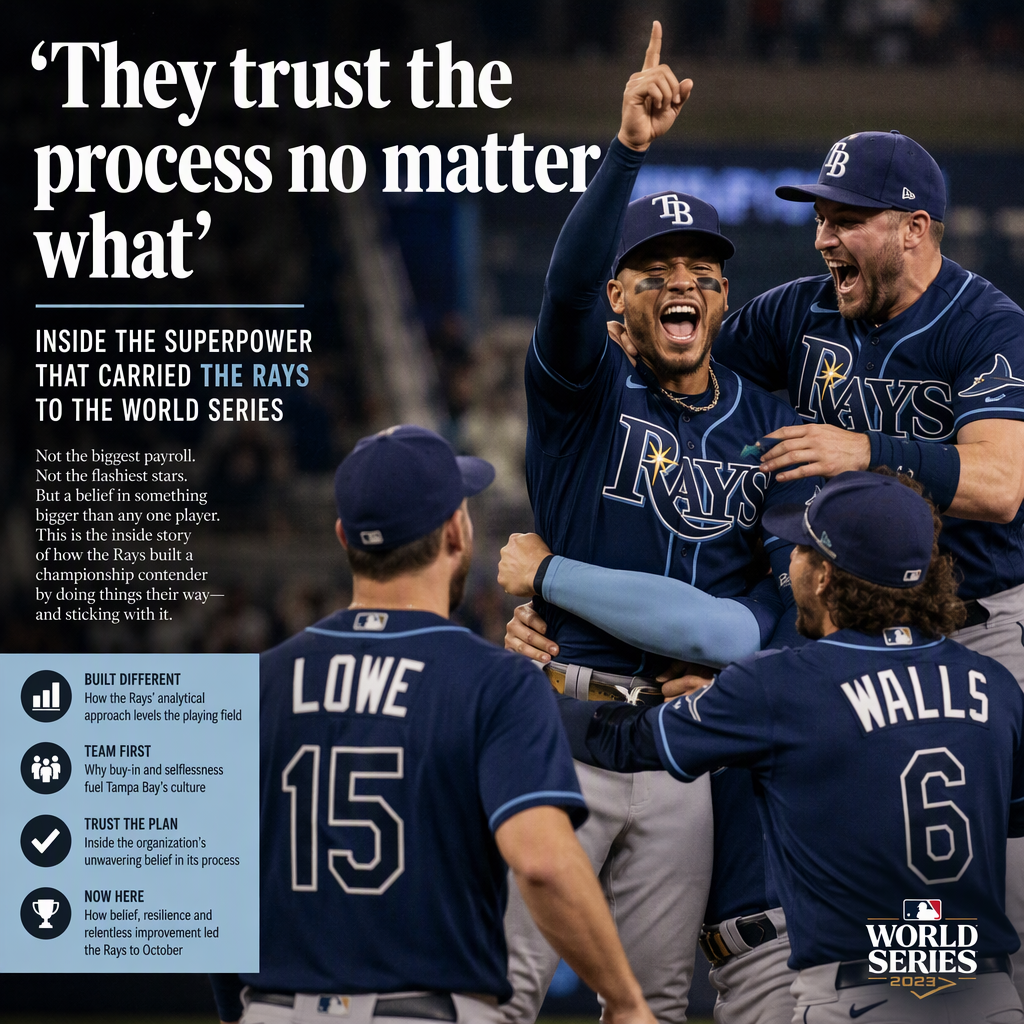
📸❌ AI illustration, not a game photo
The Real Talk
The Rays crack the code of small-market success by refusing to play the game on billionaire terms. If you’re Black and watching, this is proof that vision, adaptability, and math can outpace money and privilege, until the league remembers who runs the table and tilts it back. Tampa Bay’s hustle is a blueprint, and it’s also a warning about the limits of beating a stacked deck.
💎 クリスタル Take
The Tampa Bay Rays don’t play the same game as everybody else, and they don’t pretend to. While big-money teams are out here flexing their wallets, throwing hundred-million-dollar contracts at superstar players like it’s Monopoly money, the Rays have built their empire on thrift and tenacity. It’s not about who can spend the most. It’s about who can outthink, outmaneuver and outlast. That’s their superpower. But let’s not get too caught up in the Cinderella story, because the Rays aren’t just scrappy underdogs. They’re proof of what can happen when you work the system to your advantage. And that says something much bigger about who gets to win, who gets to compete, and whose process gets trusted in sports and beyond.
First, let’s put this small-market narrative in perspective. Yes, Tampa Bay has one of the league’s lowest payrolls, hovering around $78 million in 2023. That’s a fraction of what the Yankees or Dodgers throw around every season. But the Rays didn’t stumble into success because they’re scrappy; they engineered it. They’ve mastered the art of doing more with less, using analytics, data-driven decision-making and relentless innovation to stay steps ahead. They’re playing chess while other teams are just trying not to lose at checkers. That kind of ingenuity should be celebrated, but let’s be real about what it takes to pull this off.
The Rays’ system is built on squeezing every bit of value out of every player. That means leaning hard into development, constantly shifting roles and making tough calls that prioritize results over sentiment. If a player gets hot, they flip him for prospects before he costs them too much. If someone isn’t performing, they get cut loose fast. No loyalty, no room for attachment, it’s cold, calculated efficiency.
“Trusting the process” sounds noble when it’s attached to a franchise like the Rays, but how often do we see that same patience extended to Black leadership? How often do we see it celebrated when Black players build success by navigating systems designed to undervalue them?
That’s not a feel-good story, it’s capitalism in cleats. The Rays succeed because they embrace the ruthless logic of the system, not because they’ve somehow transcended it.
And the thing about trusting the process? That’s a privilege. It’s easier for the Rays to stick to their blueprint because it works. They’ve proven they can win this way. But when Black athletes or Black coaches talk about trusting the process, they’re not always given that same grace. Instead, their results get scrutinized harder and their methods questioned more. “Trusting the process” sounds noble when it’s attached to a franchise like the Rays, but how often do we see that same patience extended to Black leadership? How often do we see it celebrated when Black players build success by navigating systems designed to undervalue them?
There’s a lesson here, though. The Rays don’t wait for validation. They move boldly, take risks and bet on their own vision. That’s what we need to keep doing, even when folks question our process or try to make us second-guess our own plans. The Rays didn’t let their small-market status keep them small-minded, and we don’t have to let structural barriers box us in either. Push boundaries. Break molds. Trust your blueprint and keep building. Because if there’s one thing the Rays teach us, it’s this: the game is always rigged, but the right process can flip the whole board. 🏾
💡 Spreadsheet Swing Kings
The Rays turned small-market penny-pinching into an art form, proving you can outwit the big spenders if your spreadsheets swing for the fences.
⚡ Underdogs & Uneven Fields
The Rays prove that small market teams can win big when they prioritize player development and strategy over massive payrolls, but this underdog story hides the economic imbalance that keeps big-market teams locking out working-class communities from the stands. If only ownership cared about fans as much as they care about the process, maybe Tampa’s Black baseball culture wouldn’t feel priced out of its own game.